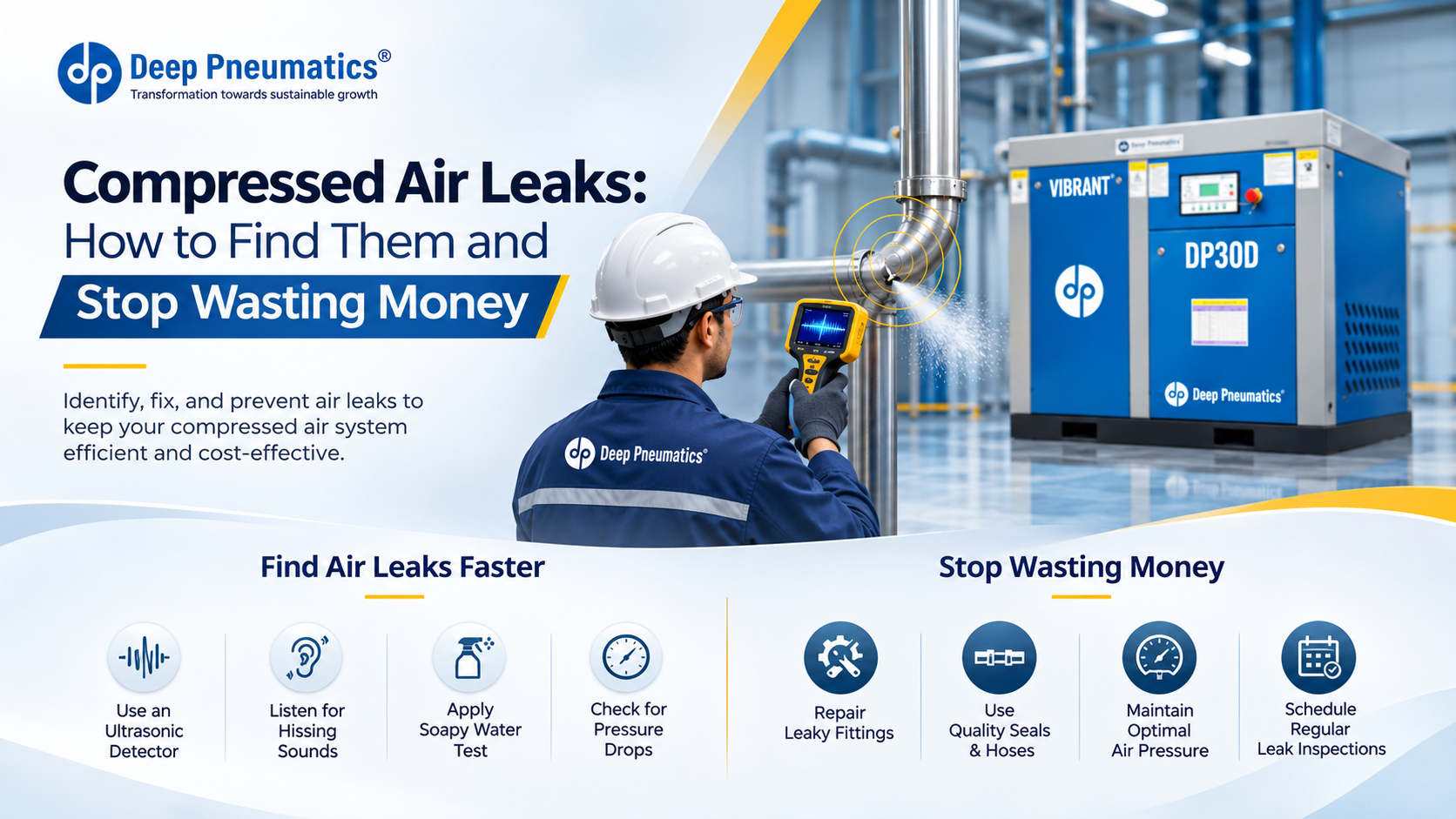
Walk through your plant on a quiet Sunday and listen closely. If you hear a faint hiss near a hose, a joint, or a valve, you have just found money escaping. Compressed air leaks are among the most common and most expensive problems in any factory.
Industry studies often put leakage at 20 to 30 percent of a compressor’s output. Because the loss is invisible, many teams ignore it. However, your electricity bill does not. In this guide, we explain where leaks hide, how to find them, and how to fix them for good.
Why Compressed Air Leaks Cost More Than You Think
Compressed air is one of the most expensive utilities in a plant. Your compressor turns electricity into air, so every leak wastes both. Moreover, the compressor runs longer to cover the loss. As a result, you pay for air that never does any work. Industrial Air Compressor Manufacturer and Suppliers in Gujarat.
Consider a simple example. A 3 mm hole at 7 bar lets out roughly 11 litres of air every second. Replacing that air takes around 4 kW of compressor power. Run it for 20 hours a day over 300 days at Rs. 8 per unit, and the bill reaches about Rs. 1.9 lakh a year. That is the price of one small hole.
Leaks also cause quieter damage. They lower system pressure, so tools run slower and machines act up. Operators then raise the pressure setting to compensate. That step increases energy use and makes the leaks even bigger. In addition, longer running hours wear out your compressor sooner.
Where Compressed Air Leaks Usually Hide
Leaks rarely come from dramatic failures. Instead, they come from small, ordinary parts. Check these spots first:
- Quick-connect couplings and hose joints that wear out with daily use
- Threaded pipe fittings that loosen after years of vibration
- Old hoses with cracks near the end fittings
- Filter bowls, regulators, and lubricators with tired seals
- Drain valves that stay partly open
- Pneumatic cylinders with worn piston seals
- Unused tools and open-ended lines that nobody closed
Notice that most of these sit near the point of use. Therefore, start your search around machines and workstations rather than in the main pipeline.
How to Find Compressed Air Leaks
Listen Carefully
First, walk the plant when machines are off and the area is quiet. Listen for hissing, then check every suspicious spot. This method costs nothing. However, it misses small leaks in a noisy shop.
Try the Soapy Water Test
Next, brush soapy water on joints, fittings, and valves. Bubbles show the exact leak point. This works well on threaded connections. Still, keep the soap away from electrical parts.
Use an Ultrasonic Leak Detector
For busy plants, an ultrasonic detector works best. It picks up the high-pitched sound that leaks make, even in loud areas. As a result, one person can survey a whole shop in a day. Many facilities book a professional leak audit once or twice a year.
Run a Simple Load Test
Finally, you can estimate total leakage with a basic test. Stop all production demand, then start the compressor. Over several cycles, note how long it runs loaded compared with unloaded. The loaded share shows roughly how much air your leaks consume. This test suits fixed-speed compressors with load and unload control.
How to Fix and Prevent Compressed Air Leaks
Finding leaks is only half the job. A good repair routine keeps them from coming back. Follow these steps:
- Tag each leak and record its location and size
- Repair the biggest leaks first for the quickest savings
- Replace worn couplings, hoses, and seals with quality parts
- Fit isolation valves so you can shut off idle sections
- Schedule regular inspections, not just a one-time check
- Ask operators to report hissing sounds the moment they hear them
Moreover, a lower system pressure reduces leakage, because every hole flows less air at lower pressure. As a rule of thumb, each 1 bar reduction saves around 6 to 7 percent of compressor energy. So find the lowest pressure your equipment truly needs, and set the compressor there.
Why a Leak Audit Pays for Itself
Most plants recover the cost of a leak audit within a few months. In fact, fixing leaks is often the cheapest energy saving you can find. You need no new machinery. You simply need attention and a plan.
On top of that, a tight system asks less from your compressors. Some plants even avoid buying a bigger machine, because repairs free up enough capacity. That saving alone can justify the effort.
Conclusion
Compressed air leaks drain money every hour your plant runs. The good news is that simple tools and steady habits can find and fix them. At Deep Pneumatics, our service team helps plants spot leaks, tune pressure settings, and keep compressed air systems efficient through AMC plans. Contact us today to book a compressed air system check for your facility.